Description
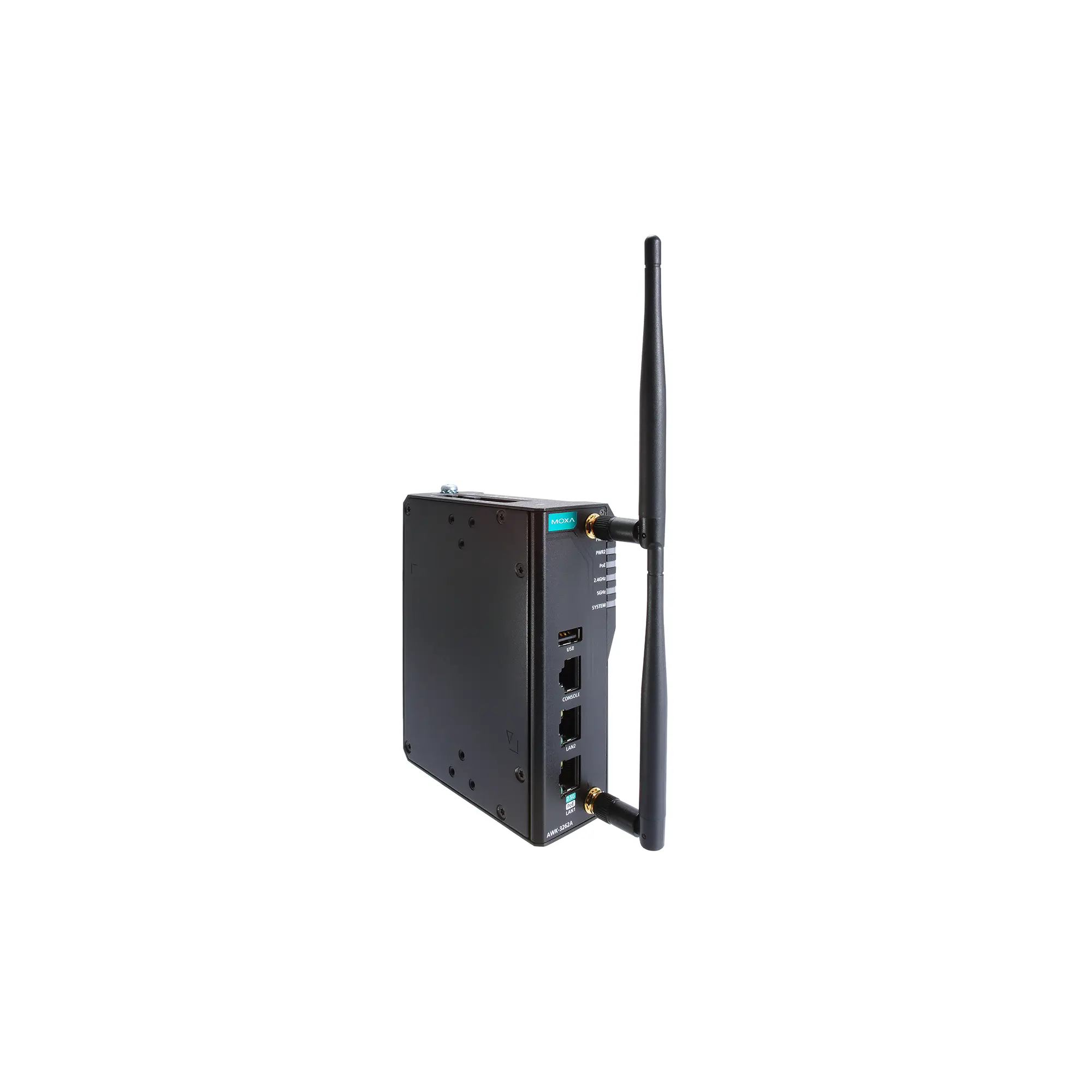
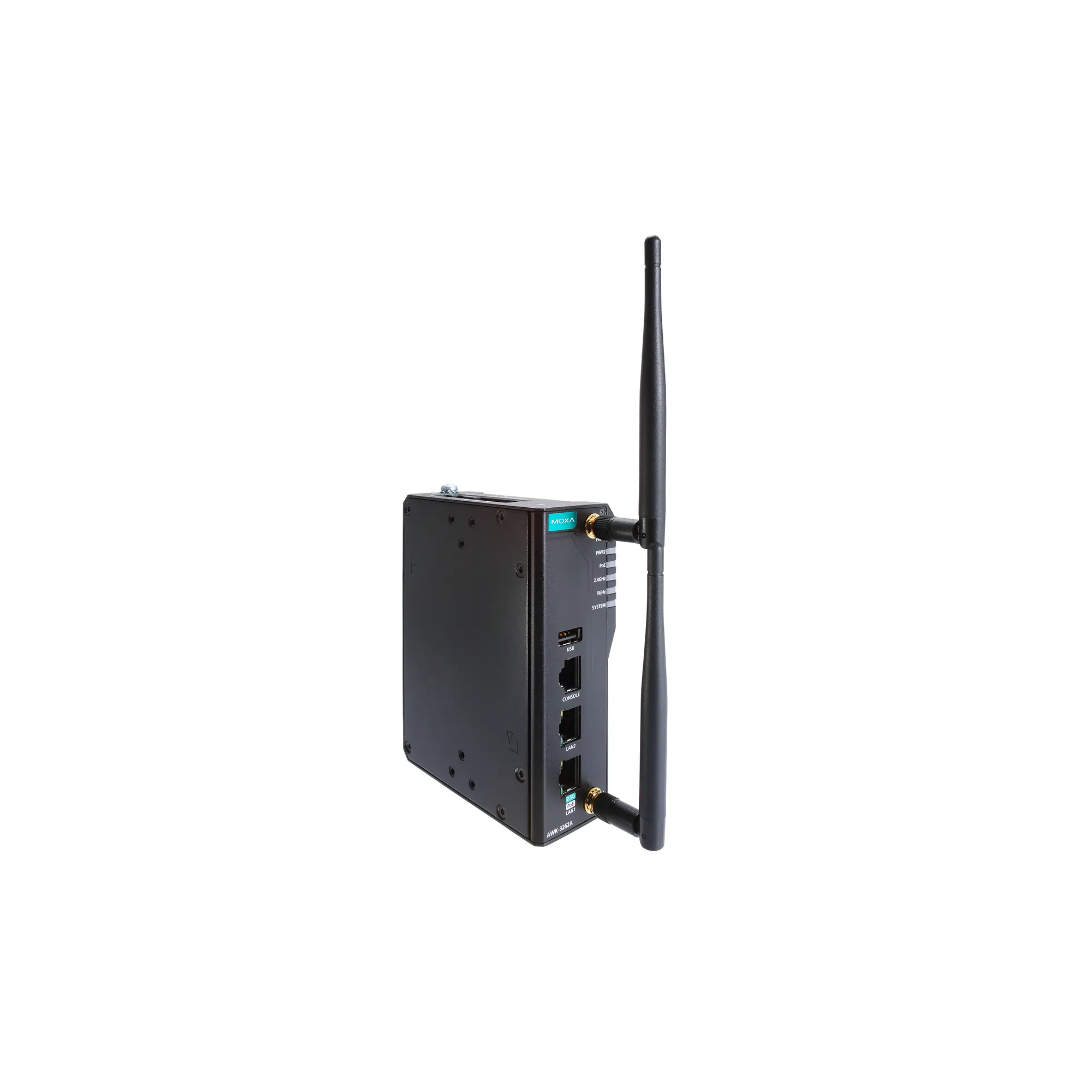
Industrial wireless AP/client – Advanced industrial Wi-Fi 6 (802.11ax) wireless AP/bridge/client with 1 10/100/1000/2500BaseT(X) and 1 10/100/1000BaseT(X) port, IP30, UN band, -25 to 60°C operating temperature
WLAN Interface
- WLAN Standards: 2.4 GHz: 802.11ax with 1024 QAM support, 20/40 MHz5 GHz: 802.11ax with 1024 QAM support, 20/40/80 MHzWMM for QoS
- Frequency Band for UN (20 MHz operating channels): 2.412 to 2.472 GHz (13 channels) Available channels change depending on the selected country or region code. 5.180 to 5.240 GHz (4 channels) 5.260 to 5.320 GHz (4 channels) DFS (Dynamic Frequency Selection) channel support: In AP mode, when a radar signal is detected, the device will automatically switch to another channel. However, according to regulations, after switching channels, a 60-second availability check period is required before starting the service. 5.500 to 5.700 GHz (11 channels) DFS (Dynamic Frequency Selection) channel support: In AP mode, when a radar signal is detected, the device will automatically switch to another channel. However, according to regulations, after switching channels, a 60-second availability check period is required before starting the service. 5.745 to 5.825 GHz (5 channels)
- Wireless Security: WPA/WPA2/WPA3-Enterprise (IEEE 802.1X/RADIUS, TKIP, AES) WPA/WPA2/WPA3-Personal
- Wireless Roaming: Turbo Roaming The Turbo Roaming recovery time indicated herein is an average of test results documented, in optimized conditions, across APs configured with interference-free 20-MHz RF channels, WPA2-PSK security, and default Turbo Roaming parameters. The clients are configured with 3-channel roaming at 100 Kbps traffic load. Other conditions may also impact roaming performance. For more information about Turbo Roaming parameter settings, refer to the product manual. 802.11k/v/r 802.11k/v are not supported in Client-based modes.
- Transmission Rate: 2.4 GHz:Up to 573.5 Mbps5 GHz:Up to 1,201 Mbps
- Transmitter Power for 802.11a (Dual Chain): 27 When the ambient operating temperature exceeds 70°C, the maximum transmitter power should be set to 24 dBm to prevent performance degradation. ±1.5 dBm @ 6 Mbps 24.5 When the ambient operating temperature exceeds 70°C, the maximum transmitter power should be set to 24 dBm to prevent performance degradation. ±1.5 dBm @ 54 Mbps
- Transmitter Power for 802.11n (5 GHz, Dual Chain): 26±1.5 dBm @ MCS0 20 MHz 22±1.5 dBm @ MCS7 20 MHz 26±1.5 dBm @ MCS0 40 MHz 22±1.5 dBm @ MCS7 40 MHz
- Transmitter Power for 802.11ac (Dual Chain): 26±1.5 dBm @ MCS0 20 MHz 22±1.5 dBm @ MCS8 20 MHz 25±1.5 dBm @ MCS0 40 MHz 21±1.5 dBm @ MCS9 40 MHz 25±1.5 dBm @ MCS0 80 MHz 21±1.5 dBm @ MCS9 80 MHz
- Transmitter Power for 802.11ax (Dual Chain): 25±1.5 dBm @ MCS0 20 MHz 20±1.5 dBm @ MCS11 20 MHz 25±1.5 dBm @ MCS0 40 MHz 20±1.5 dBm @ MCS11 40 MHz 25±1.5 dBm @ MCS0 80 MHz 20±1.5 dBm @ MCS11 80 MHz
- Transmitter Power for 802.11b (Dual Chain): 29 When the ambient operating temperature exceeds 70°C, the maximum transmitter power should be set to 26 dBm to prevent performance degradation. ±1.5 dBm @ 1 Mbps 29 When the ambient operating temperature exceeds 70°C, the maximum transmitter power should be set to 26 dBm to prevent performance degradation. ±1.5 dBm @ 11 Mbps
- Transmitter Power for 802.11g (Dual Chain): 27±1.5 dBm @ 6 Mbps 26±1.5 dBm @ 54 Mbps
- Transmitter Power for 802.11n (2.4 GHz, Dual Chain): 26±1.5 dBm @ MCS0 20 MHz 24±1.5 dBm @ MCS7 20 MHz 26±1.5 dBm @ MCS0 40 MHz 24±1.5 dBm @ MCS7 40 MHz
- Transmitter Power for 802.11ac (2.4 GHz, Dual Chain): 26±1.5 dBm @ MCS0 20 MHz 24±1.5 dBm @ MCS8 20 MHz 26±1.5 dBm @ MCS0 40 MHz 23±1.5 dBm @ MCS9 40 MHz