Description
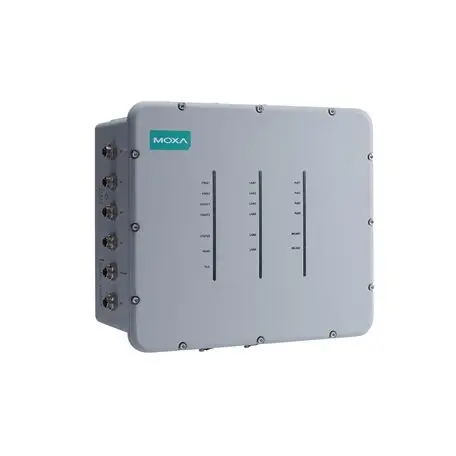
Industrial wireless AP/client – Wi-Fi 4 (802.11n) railway wayside outdoor train-to-ground dual-radio wireless AP, IP68, EU band, -40 to 75°C operating temperature, conformal coating
WLAN Interface
- Channel Bandwidth: 20 MHz, 40 MHz
- Frequency Band: 5 GHz 2.4 GHz
- Frequency Band for EU (20 MHz operating channels): 2.412 to 2.472 GHz (13 channels) 5.180 to 5.240 GHz (4 channels) 5.260 to 5.320 GHz (4 channels) 5.500 to 5.700 GHz (11 channels)
- Frequency Band for JP (20 MHz operating channels): 2.412 to 2.484 GHz (14 channels) 5.180 to 5.240 GHz (4 channels) 5.260 to 5.320 GHz (4 channels) 5.500 to 5.700 GHz (11 channels)
- Frequency Band for US (20 MHz operating channels): 2.412 to 2.462 GHz (11 channels) 5.180 to 5.240 GHz (4 channels) 5.260 to 5.320 GHz (4 channels) DFS (Dynamic Frequency Selection) channel support: In AP mode, when a radar signal is detected, the device will automatically switch to another channel. However, according to regulations, after switching channels, a 60-second availability check period is required before starting the service. 5.500 to 5.700 GHz (8 channels) Excludes 5.600 to 5.640 DFS (Dynamic Frequency Selection) channel support: In AP mode, when a radar signal is detected, the device will automatically switch to another channel. However, according to regulations, after switching channels, a 60-second availability check period is required before starting the service. 5.745 to 5.825 GHz (5 channels)
- Receiver Sensitivity for 802.11a (measured at 5.680 GHz): Typ. -90 @ 6 Mbps Typ. -88 @ 9 Mbps Typ. -88 @ 12 Mbps Typ. -85 @ 18 Mbps Typ. -81 @ 24 Mbps Typ. -78 @ 36 Mbps Typ. -74 @ 48 Mbps Typ. -74 @ 54 Mbps Note: Due to a limitation in the receiver sensitivity performance for channels 153 and 161, it is recommended to avoid using these channels in your critical applications.
- Receiver Sensitivity for 802.11n (5 GHz; measured at 5.680 GHz): Typ. -88 dBm @ MCS0 20 MHz Typ. -85 dBm @ MCS1 20 MHz Typ. -82 dBm @ MCS2 20 MHz Typ. -79 dBm @ MCS3 20 MHz Typ. -76 dBm @ MCS4 20 MHz Typ. -71 dBm @ MCS5 20 MHz Typ. -70 dBm @ MCS6 20 MHz Typ. -69 dBm @ MCS7 20 MHz Typ. -95 dBm @ MCS8 20 MHz Typ. -91 dBm @ MCS9 20 MHz Typ. -87 dBm @ MCS10 20 MHz Typ. -80 dBm @ MCS11 20 MHz Typ. -78 dBm @ MCS12 20 MHz Typ. -74 dBm @ MCS13 20 MHz Typ. -72 dBm @ MCS14 20 MHz Typ. -71 dBm @ MCS15 20 MHz Typ. -84 dBm @ MCS0 40 MHz Typ. -81 dBm @ MCS1 40 MHz Typ. -77 dBm @ MCS2 40 MHz Typ. -75 dBm @ MCS3 40 MHz Typ. -71 dBm @ MCS4 40 MHz Typ. -67 dBm @ MCS5 40 MHz Typ. -64 dBm @ MCS6 40 MHz Typ. -63 dBm @ MCS7 40 MHz Typ. -90 dBm @ MCS8 40 MHz Typ. -85 dBm @ MCS9 40 MHz Typ. -82 dBm @ MCS10 40 MHz Typ. -81 dBm @ MCS11 40 MHz Typ. -77 dBm @ MCS12 40 MHz Typ. -73 dBm @ MCS13 40 MHz Typ. -71 dBm @ MCS14 40 MHz Typ. -68 dBm @ MCS15 40 MHz Note: Due to a limitation in the receiver sensitivity performance for channels 153 and 161, it is recommended to avoid using these channels in your critical applications.
- Receiver Sensitivity for 802.11b (measured at 2.437 GHz): Typ. -93 dBm @ 1 Mbps Typ. -93 dBm @ 2 Mbps Typ. -93 dBm @ 5.5 Mbps Typ. -88 dBm @ 11 Mbps
- Receiver Sensitivity for 802.11g (measured at 2.437 GHz): Typ. -88 dBm @ 6 Mbps Typ. -86 dBm @ 9 Mbps Typ. -85 dBm @ 12 Mbps Typ. -85 dBm @ 18 Mbps Typ. -85 dBm @ 24 Mbps Typ. -82 dBm @ 36 Mbps Typ. -78 dBm @ 48 Mbps Typ. -74 dBm @ 54 Mbps
- Receiver Sensitivity for 802.11n (2.4 GHz; measured at 2.437 GHz): Typ. -89 dBm @ MCS0 20 MHz Typ. -85 dBm @ MCS1 20 MHz Typ. -85 dBm @ MCS2 20 MHz Typ. -82 dBm @ MCS3 20 MHz Typ. -78 dBm @ MCS4 20 MHz Typ. -74 dBm @ MCS5 20 MHz Typ. -72 dBm @ MCS6 20 MHz Typ. -70 dBm @ MCS7 20 MHz Typ. -95 dBm @ MCS8 20 MHz Typ. -90 dBm @ MCS9 20 MHz Typ. -87 dBm @ MCS10 20 MHz Typ. -83 dBm @ MCS11 20 MHz Typ. -